Quick answer
Our overall pick is the Bushnell H2O Xtreme for its proven waterproof rating and rugged build. The Gosky model is best for those wanting smartphone compatibility, while the Celestron offers a classic design and the Zeiss provides premium optical precision.
Choosing the right pair of binoculars can transform your time outdoors, bringing distant birds and wildlife into sharp, brilliant focus. For many enthusiasts, a 10×42 configuration offers a great balance of magnification, light gathering, and portability. We compared the manufacturer specifications and features of several leading models to help you find the best binoculars for bird watching and general wildlife observation.
Our picks at a glance

Pros
- IPX7 waterproof rating for submersion protection
- Nitrogen purged to prevent internal fogging
- Includes BaK-4 prisms and fully multi-coated lenses
- Comes with carrying case and lens covers
Cons
- The listing does not mention a smartphone adapter
- Manual focus only

Pros
- Includes a smartphone adapter for photography
- Features BAK4 prism and FMC optics
- Nitrogen-filled for fog resistance
- Lightweight design with a wide field of view
Cons
- The listing advises against immersing in water
- The listing does not specify the field of view or eye relief
Pros
- Phase-coated BaK-4 prisms for enhanced contrast
- Fully multi-coated lenses
- Waterproof and nitrogen-purged housing
- Built-in tripod adapter socket
Cons
- Lower listed field of view (5.8°) than some models
- The listing does not mention a smartphone adapter

Pros
- Hydrophobic multi-coating for brilliant images
- Long 18mm eye relief
- Wide operating temperature range
- Waterproof construction
Cons
- Higher weight listed (2 pounds)
- The listing does not mention included accessories like a case
How we chose
Our editors compared the manufacturer listings and specifications for widely used 10×42 binoculars on Amazon as of October 2026. We did not test or handle any products. Our analysis focused on key criteria for field use: optical quality (prism type and lens coatings), durability (waterproof and fogproof construction), ergonomic features, and included accessories.
Best Binoculars for Wildlife Watching: our picks in detail
1. Best overall: Bushnell H2O Xtreme 10×42
The Bushnell H2O Xtreme 10×42 binoculars are built for reliability in wet conditions. They feature an O-ring sealed optical system with an IPX7 waterproof rating, meaning they are designed to survive accidental submersion. Nitrogen purging prevents internal fogging, and the rugged rubber armor provides a secure, non-slip grip.
Optics include premium BaK-4 prisms and fully multi-coated glass surfaces for clear, bright images. They have a 6.8-degree field of view and 17mm of eye relief. The package includes a strap, carrying case, and lens covers, making them a complete kit for birdwatching, boating, or general nature viewing.
Best for: Birders and outdoor enthusiasts who need a rugged, fully waterproof optic for use in all weather conditions.
Pros
- IPX7 waterproof rating for submersion protection
- Nitrogen purged to prevent internal fogging
- Includes BaK-4 prisms and fully multi-coated lenses
- Comes with carrying case and lens covers
Cons
- The listing does not mention a smartphone adapter
- Manual focus only
2. Best for smartphone photography: Gosky 10×42 Binoculars
The Gosky 10×42 binoculars are designed for versatility, including a smartphone adapter to capture photos and videos through the optics. They feature a BAK4 prism and green FMC (fully multi-coated) anti-reflective coating to improve light transmission and image sharpness.
The binoculars are nitrogen-filled and O-ring sealed for protection against dust and moisture, though the listing advises not to immerse them in water. The durable framework has a rubber armor for a non-slip, shock-proof grip. They are easy to use with a center focus wheel and right eyepiece diopter adjustment.
Best for: Observers who want to easily document and share their sightings with a included smartphone adapter.
Pros
- Includes a smartphone adapter for photography
- Features BAK4 prism and FMC optics
- Nitrogen-filled for fog resistance
- Lightweight design with a wide field of view
Cons
- The listing advises against immersing in water
- The listing does not specify the field of view or eye relief
3. Best for classic birding: Celestron Nature DX 10×42
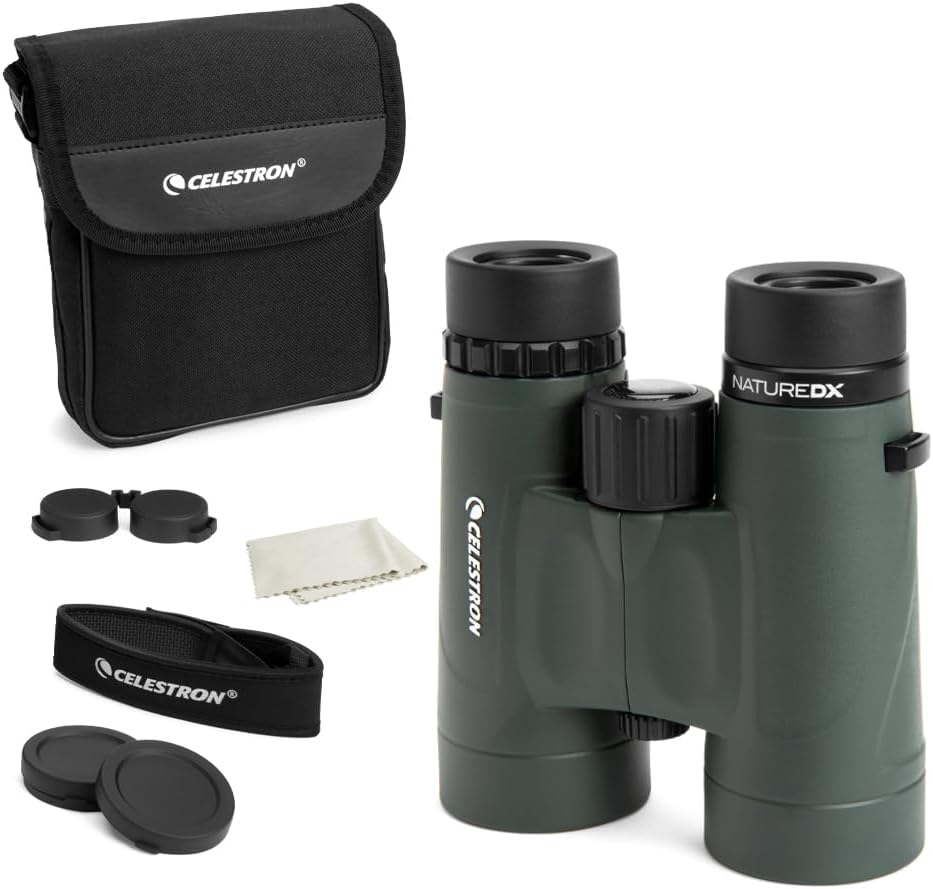
The Celestron Nature DX 10×42 binoculars offer a compact, lightweight design tailored for birdwatching and hiking. They provide bright, sharp views through fully multi-coated lenses and phase-coated BaK-4 prisms, which enhance contrast and resolution.
The housing is rubber-armored polycarbonate for durability and is both waterproof and nitrogen-purged to resist fogging. They feature a built-in tripod adapter socket for stable, extended viewing, though the adapter is not included. The field of view is listed as 5.8 degrees with 14mm of eye relief.
Best for: Traditional birdwatchers and hikers seeking a balanced, weather-ready optic with proven optical coatings.
Pros
- Phase-coated BaK-4 prisms for enhanced contrast
- Fully multi-coated lenses
- Waterproof and nitrogen-purged housing
- Built-in tripod adapter socket
Cons
- Lower listed field of view (5.8°) than some models
- The listing does not mention a smartphone adapter
4. Best for optical precision: Zeiss Terra ED 10×42
The Zeiss Terra ED 10×42 binoculars are built for optical performance with a hydrophobic multi-coating the maker says keeps images bright. They offer a 6.2-degree apparent field of view and 18mm of eye relief for comfortable viewing.
These binoculars are waterproof and designed for an operating temperature range from 24 to 140 degrees Fahrenheit, making them a reliable companion in extreme conditions. The compact design is suitable for birdwatching and nature observation. They are tripod-mountable and feature a center focus system.
Best for: Observers who prioritize premium lens coatings and optical clarity above all else.
Pros
- Hydrophobic multi-coating for brilliant images
- Long 18mm eye relief
- Wide operating temperature range
- Waterproof construction
Cons
- Higher weight listed (2 pounds)
- The listing does not mention included accessories like a case
Our picks at a glance
| Model | Waterproof Rating | Prism / Coating | Tripod Mount | Special Feature |
|---|---|---|---|---|
| Bushnell H2O Xtreme 10×42 | IPX7 (Submersible) | BaK-4 / Fully Multi-Coated | Yes | Rugged rubber armor |
| Gosky 10×42 | IPX7 (Do not immerse) | BAK4 / FMC | Yes | Includes smartphone adapter |
| Celestron Nature DX 10×42 | Waterproof | BaK-4 / Phase & Fully Multi-Coated | Yes (adapter not included) | Phase-coated prisms |
| Zeiss Terra ED 10×42 | Waterproof | Roof Prism / Hydrophobic Multi-Coated | Yes | Hydrophobic coating |
How to choose the best binoculars for bird watching
Selecting binoculars is about matching specifications to your primary activities. For wildlife observation, a 10×42 configuration is a versatile choice, offering enough magnification to see detail at a distance while the 42mm objective lenses gather sufficient light for dawn or dusk viewing.
What to look for
- Optical Quality: Look for BaK-4 prisms, which are generally higher quality than BK-7. Lens coatings like “fully multi-coated” or “phase-coated” increase light transmission and image contrast, crucial for identifying birds in shadowy forests.
- Durability: For field use, waterproof and fogproof construction is essential. Nitrogen or argon purging prevents internal fogging when temperatures change. Rubber armor protects against bumps and provides a secure grip.
- Ergonomics: Consider eye relief (distance from the eyepiece to your eye), especially if you wear glasses; 15mm or more is recommended. Field of view, measured in degrees or feet at 1000 yards, determines how wide a scene you can see.
- Extras: A tripod mount allows for stable, extended viewing. Some models include smartphone adapters, which are great for digiscoping but add bulk. Always check what accessories are included, like a case and lens covers.
For more detailed guidance on using optics in the field, see our article on Binoculars for Wildlife Observation. Remember to follow all manufacturer instructions for care, especially regarding cleaning and water exposure.
FAQ
What does 10×42 mean?
The first number (10x) is the magnification, meaning an object will appear ten times closer than it would to the naked eye. The second number (42) is the diameter of the objective (front) lenses in millimeters, which affects how much light the binoculars can gather.
Are all “waterproof” binoculars submersible?
Not necessarily. Terms vary by manufacturer. An IPX7 rating, like on the Bushnell model, indicates protection against temporary immersion. Other listings may state “waterproof” but advise against submersion, like the Gosky. Always check the specific water resistance claims in the product details.
Why is eye relief important?
Eye relief is the distance from the eyepiece lens to the point where you see the full field of view. Longer eye relief (typically 15mm or more) is crucial for comfortable viewing if you wear eyeglasses, as it allows you to see the entire image without pressing the lenses against your glasses.
Do I need a tripod adapter for bird watching?
For extended viewing sessions, a tripod adapter can prevent arm fatigue and provide a rock-steady image, which is helpful for identifying fine details on distant birds. Most of the models we compared have a built-in socket, but you may need to purchase the adapter separately.
References
- Amazon product listings and manufacturer specifications (accessed October 2026)
- National Park Service – Watching Wildlife