By Owen Palmer
Updated November 2026
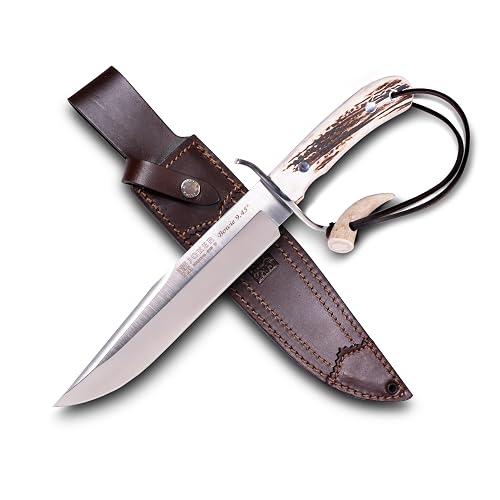
A hunting knife and a dagger can both be carried in the field, but they were built for different jobs. A hunting knife is a working tool for field dressing, skinning and camp chores, while a dagger is a double-edged, piercing blade designed primarily for close-quarters use. For most deer and small game hunters, a hunting knife is the better pick. A dagger suits readers who want a secondary or ceremonial blade and don’t plan to do much skinning.
| Criteria | Hunting Knife | Dagger |
|---|---|---|
| Blade shape | Single edge, often with a drop point or clip point | Double edge, symmetrical, tapered point |
| Field dressing | Strong, controlled cuts through hide and cartilage | Limited; the tip and edges are not ideal for opening a body cavity |
| Skinning | Designed for it, with a belly and curve that follow the hide | Awkward for long, even cuts |
| Piercing and thrusting | Adequate, but not the primary purpose | Excellent, with a narrow point |
| Sheath and carry | Belt sheath, easy to access while kneeling | Often worn in a sheath on a belt or boot; more restrictive for some hunters |
Blade Shape and Edge Design
A hunting knife usually has a single cutting edge with a spine that is thick enough to take abuse and a belly that curves smoothly. Drop point and clip point profiles are common because they give controlled tip work without a fragile point. A dagger uses two sharpened edges meeting at a narrow tip, which is excellent for penetration but leaves less material to work with when you need to guide a cut. Winner: hunting knife for general field work. Hunting Knife vs Bowie Knife (2026): Which Is Better for Field Use? goes further into this.
Field Dressing and Skinning Performance
For breaking down game, the hunting knife has the advantage. Its single edge lets you run the blade along the hide with the edge facing outward, reducing the chance of nicking meat or intestines. A dagger’s double edge makes that technique harder, and its narrow profile can be less stable during longer cuts. Owners often report that daggers feel better for quick, precise thrusts than for processing an animal. Winner: hunting knife.
Carry Comfort and Versatility in Camp
A hunting knife handles camp tasks such as cutting rope, batoning kindling in some designs, and opening packages, because its shape and thickness are built for repeated use. A dagger is lighter to carry in some cases and more discreet, which some hunters prefer for backup carry. Its versatility is narrower, though, and it can feel out of place during everyday tasks. Winner: hunting knife for all-around use, with a dagger suited to dedicated backup.
Pros & Cons
Hunting Knife
- Pro: Single edge and controlled belly make skinning and field dressing practical.
- Pro: Handles camp chores along with game processing.
- Con: Less effective as a thrusting or piercing weapon.
Dagger
- Pro: Narrow, double-edged point is strong for piercing.
- Pro: Often slim and easy to carry as a backup blade.
- Con: Poorly suited to skinning and field dressing.
Which Should You Choose?
Match the blade to the work you plan to do:
- Choose a hunting knife if you deer hunt, skin game, or want one blade for the whole trip. View on Amazon is a common example of a field-oriented design.
- Choose a dagger if you want a slim backup blade or a piece for display and occasional use. View on Amazon
If you are still deciding between fixed and folding designs, the guide Folding vs Fixed Blade Hunting Knife (2026): Which Is Better for Field Use? covers the trade-offs in more detail. For a broader comparison of blade styles, see Hunting Knife vs Combat Knife: Which Blade Fits Your Hunt?. Hunters looking for a dedicated skinning option can read Skinning Knife for Hunting: How to Choose and Use One (7 Steps).
FAQ
Can a dagger be used as a hunting knife?
A dagger can cut in an emergency, but its double edge and narrow tip make skinning and field dressing harder. Most hunters who process their own game prefer a single-edged hunting knife.
Is a dagger legal to carry while hunting?
Knife laws vary by state, and some places restrict double-edged blades or fixed blades of certain lengths. Check your state and local regulations before you carry either blade afield. You may also like 150d vs 300d Hunting Blind (2026): Which Is Better for Deer Hunters?.
What blade length works best for a hunting knife?
Many hunters choose a blade in the range of about three to four inches for skinning and detail work, with a slightly longer blade for general camp use. Choose what feels controllable in your hand. For another angle, check out Bushcraft vs Hunting Knife (2026): Which Is Better for Field Use?.
Conclusion
For most hunters, the hunting knife is the more useful choice because it handles skinning, field dressing and camp tasks well. A dagger still has a role as a slim backup or piercing blade, but it should not replace a dedicated hunting knife in your pack.
Related reading
- Knife Hunting and Fishing (2026): Fixed Blade vs Folding Knife, Which Is Better?
- Hunting Knife vs Combat Knife BF6: Which Blade Fits Your Hunt?
About Owen Palmer
Owen Palmer is part of our editorial team and reviews and edits our hunting guides, checking product details against manufacturer specifications and owner feedback.