
 By Owen Palmer
Updated November 2026
The nikon coolshot proii stabilized golf rangefinder is a laser unit aimed at golfers who want slope-corrected yardage, a steady image through the eyepiece, and a body that can handle rain and wet fairways. It makes the most sense for mid-to-high handicap players who play courses with noticeable elevation changes and want a straightforward device without a lot of extra modes to learn. It is less compelling for golfers who only play flat, short courses and rarely need slope data, and for buyers who want the newest Nikon feature set, since the ProIII line adds more modes and a bundle-oriented lineup. Think of this as a research-based look at what the listing and the model’s published specifications suggest, not a record of hands-on use.

Nikon COOLSHOT PROII STABILIZED Golf Rangefinder | Waterproof & stabilized laser rangefinder with slope, OLED display | Official Nikon USA Model
Product Overview
The COOLSHOT PROII STABILIZED sits in Nikon’s golf lineup as a compact, handheld laser rangefinder built around a few core promises: accurate distance to the flag or a target, slope compensation so the number on the screen reflects how the shot plays, and image stabilization to reduce the jitter that makes small targets hard to lock onto at longer distances. The listing identifies it as a waterproof, stabilized laser rangefinder with slope and an OLED display, sold as an official Nikon USA model.
In practice, that positions it as a golf-only tool rather than a multi-purpose optic. You point it at the pin or a landing area, press the trigger, and read the yardage on the display. The stabilization feature is the main thing separating it from simpler laser units, because a steadier reticle makes it easier to hit a flagstick or a small target without the reading bouncing around. Owners who compare it against non-stabilized rangefinders often describe that steadiness as the difference they notice first, particularly on windy days or when the device is held one-handed.
Because it is a single-purpose golf device, the buying decision comes down to whether you need slope data, how often you play in wet conditions, and how much you value a stabilized view. If those three points matter to you, the model is built around them. If they do not, a simpler and less specialized unit may fit your game better.
Key Features & Specifications
The table below lists only the features that the product name and listing state, plus general characteristics that Nikon’s own golf rangefinders are known for. Confirm exact range, accuracy and battery figures on the current Nikon product page before you buy, as these can change between model revisions.
| Feature | What It Means for You |
|---|---|
| Laser rangefinding for golf | Measures distance to the flag, a hazard edge or a landing zone for play on the course. |
| Slope compensation | Adjusts the displayed yardage to reflect uphill or downhill lies, so the number is closer to the playing distance. |
| Stabilized image | Reduces hand movement so the target stays steadier in the display, which helps with small targets at distance. |
| Waterproof construction | Designed for use in rain and wet conditions common on golf courses. |
| OLED display | Shows yardage readings with good contrast in typical outdoor light. |
| Official Nikon USA model | Sold with the Nikon USA warranty and support channel. |
Manufacturers in this category usually specify ranging ranges, accuracy tolerances and battery types in the product manual. Check those figures directly before you commit, since they determine whether the unit fits your typical hole lengths and how long a battery will last between changes.
Pros & Cons
Pros
- Stabilized view makes small targets like flagsticks easier to hold steady at longer distances.
- Slope compensation gives a more playable number on hilly courses.
- Waterproof body suits rainy rounds and damp mornings on the course.
- OLED display is generally easy to read in bright sunlight.
- Single-purpose layout keeps the menu simpler than multi-mode units.
- Official Nikon USA model supports warranty and service routes.
Cons
- Stabilization and slope features add complexity compared with basic rangefinders many golfers already own.
- Owners sometimes report a short learning curve before they trust slope readings on unfamiliar courses.
- Battery replacement is a recurring maintenance item, and the specific cell type should be confirmed before purchase.
- Newer Nikon models in the same family add modes and bundle options that some buyers may prefer.
- As a dedicated golf tool, it offers little use outside the course.
Performance Analysis
Performance for a laser rangefinder comes down to three things: how quickly it locks onto a target, how steady the reading stays while you hold it, and how closely the slope-adjusted number matches the real playing distance. The stabilized design is aimed squarely at the second point. Holding any optic steady at a long distance is hard, and image stabilization works by counteracting small hand movements so the reticle sits on the target longer. For golfers who range flagsticks at 150 yards and beyond, that steadiness tends to reduce the number of attempts needed to get a clean reading.
Slope compensation is where the device earns its place on hilly courses. Without slope, a rangefinder reports straight-line distance, which can differ from the effective distance when the ball is played uphill or downhill. A slope-adjusted reading gives a number that is more useful for club selection, though the adjustment is an estimate and should be treated as guidance rather than a guarantee. Golfers should still factor in wind, lie and their own swing tendencies.
Owner feedback patterns for this type of device commonly mention three themes: the stabilized view feels noticeably steadier than standard units, the display reads well in sun, and the waterproof body holds up in typical rain. Recurring complaints tend to focus on the time it takes to learn when to trust the slope reading and on the need to keep a spare battery on hand. Those patterns are consistent with what the specifications suggest, and they point to a device that rewards a short practice session before a round.
Where performance may disappoint is in very low-contrast conditions, such as dense shade or heavy fog, where any laser unit can struggle to pick up a target. Accuracy can also drop if the target is a dark or non-reflective surface, or if the beam hits a branch or fence in front of the flag. Treat the reading as a strong starting point and confirm with course markers when you can.
Who Should Buy This Product?
This model fits golfers who play hilly or varied courses and want slope-corrected numbers without building a complicated routine. It also suits players who regularly play in wet weather and want a sealed body they do not have to baby. Golfers who struggle to hold a steady reading on flagsticks at distance will likely notice the stabilization benefit most. If you already own a reliable basic rangefinder and play mostly flat, short courses, the upgrade may not change your scoring enough to justify the switch.
Skip it if you want the newest feature set in the Nikon golf lineup, if you prefer a very simple device with minimal settings, or if you need a rangefinder that doubles as a hunting or general-purpose optic. Those buyers are better served by a different model in the same family or a unit built for their specific use.
Buying Guide
Before buying any golf rangefinder, decide which features you actually need. Start with slope: if most of your rounds are on flat terrain, you may not use slope data often, and a non-slope unit can save you time and money on the learning curve. Next, consider stabilization. It is most valuable when you range small targets at long distances or when you hold the device one-handed in wind. Waterproofing matters for anyone who plays in rain or early-morning dew, and an OLED display is a good match for bright sunny rounds. Finally, check the battery type and how the manufacturer specifies battery life, since replacing a cell mid-season is an easy item to forget.
Within the same general category, a few well-known alternatives are worth comparing. The Nikon COOLSHOT PROIII STABILIZED offers a newer generation of stabilized golf ranging in the same family, with additional modes and a bundled configuration in some listings.
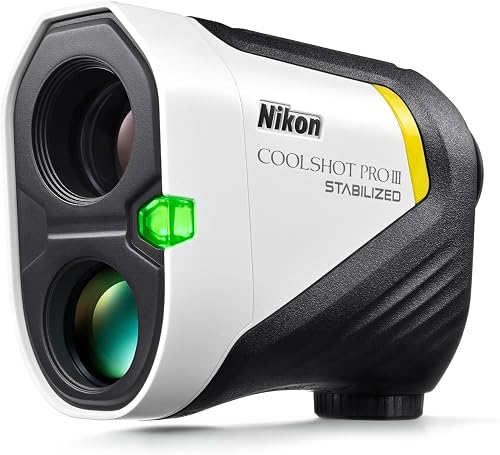
NikonWaterproof 6X Monocular Optics with Hyper Read, Slope Compensation & Dual Locked ON Quake, Golf & Actual Distance Modes COOLSHOT PROIII STABILIZED Golf Laser Rangefinder
The Nikon COOLSHOT PRO III STABILIZED 6×21 Golf Rangefinder bundle is another option for golfers who want the same family of features with included accessories. Bundle contents vary, so read the listing carefully to confirm what is in the box.

NikonFor Golf Distance Measurement | Slope Compensation | 8-1200 yd Range | OLED Display | Includes Camera Bag (2pc Bundle) COOLSHOT PRO III STABILIZED 6×21 Golf Rangefinder (16788) Bundle
If you are browsing the broader category rather than sticking to one brand, it helps to read a few comparison guides before deciding. For a wider look at slope-capable units, see 5 Best Rangefinder Golfs with Slope Picks for Accurate Yardage (2026). If you are weighing a golf GPS option instead of a laser, Bushnell Golf GPS Rangefinder: How to Choose and Use One (2026) covers the trade-offs. For a direct comparison with a Nikon model in the same family, Nikon Rangefinder for Golf Review: Is the COOLSHOT PROII Worth It? and Nikon COOLSHOT 20 Golf Laser Rangefinder Review: Features and Performance are useful reads. Golfers who also use phone apps may find Which Golf GPS Rangefinder App Is Right for You? Features and Setup Tips helpful for planning rounds.
FAQ
Is the nikon coolshot proii stabilized golf rangefinder allowed in tournament play?
Rules on rangefinders vary by event and by governing body. Many recreational and club rounds permit them, while some competitions restrict slope or distance-measuring features. Check the local rules or the tournament notice before you play, and confirm the setting you intend to use is permitted.
How does the stabilization feature help in practice?
Stabilization reduces small hand movements so the target stays steadier in the display. That usually makes it easier to hold a flagstick at distance and get a reading on the first or second try. The benefit is most noticeable at longer ranges and in wind.
Does slope compensation replace judgment on the course?
No. Slope adjustment gives a playing-distance estimate, but wind, lie, elevation and your own swing still matter. Use the number as a starting point and combine it with your experience and course knowledge.
Is the device waterproof enough for heavy rain?
The listing describes the unit as waterproof, which suits rainy rounds. Still, dry it after use, keep the battery compartment sealed, and check the manufacturer’s stated protection rating in the manual.
What kind of battery does it use, and how often will I need to change it?
Battery type and life are listed in the manufacturer’s manual and product page. Replacement frequency depends on how often you use the trigger and the display. Keeping a spare battery in your bag is a sensible habit for any laser rangefinder.
Can I use it for hunting or other outdoor activities?
It is designed as a golf rangefinder, and its slope and golf-oriented modes are tuned for course use. If you need a rangefinder for hunting, a model built for that purpose will generally fit those needs better.
How should I practice with it before a round?
Spend a short session ranging known distances on a practice range or a familiar course. Compare the readings with yardage markers and check how the slope reading changes on uneven ground. This builds trust in the device before it counts in a round.
Should I buy the newest model instead?
Newer models in the same family often add modes and accessory options. If those extras matter to you, compare the current listings. If you want a focused, single-purpose unit with stabilization and slope, this model covers those needs directly.
Final Verdict
The nikon coolshot proii stabilized golf rangefinder earns its place for golfers who want slope-corrected yardage, a steadier view through the optic, and a waterproof body that can handle wet rounds. It is a focused tool rather than a multi-purpose one, and its value depends on whether you play hilly courses and struggle with steadiness at distance. Golfers on flat, short courses or those who already have a reliable basic unit may find the upgrade less compelling. Before buying, confirm current specifications, battery type and tournament rules for your events.
About Owen Palmer
Owen Palmer is part of our editorial team and reviews and edits our hunting guides, checking product details against manufacturer specifications and owner feedback.


